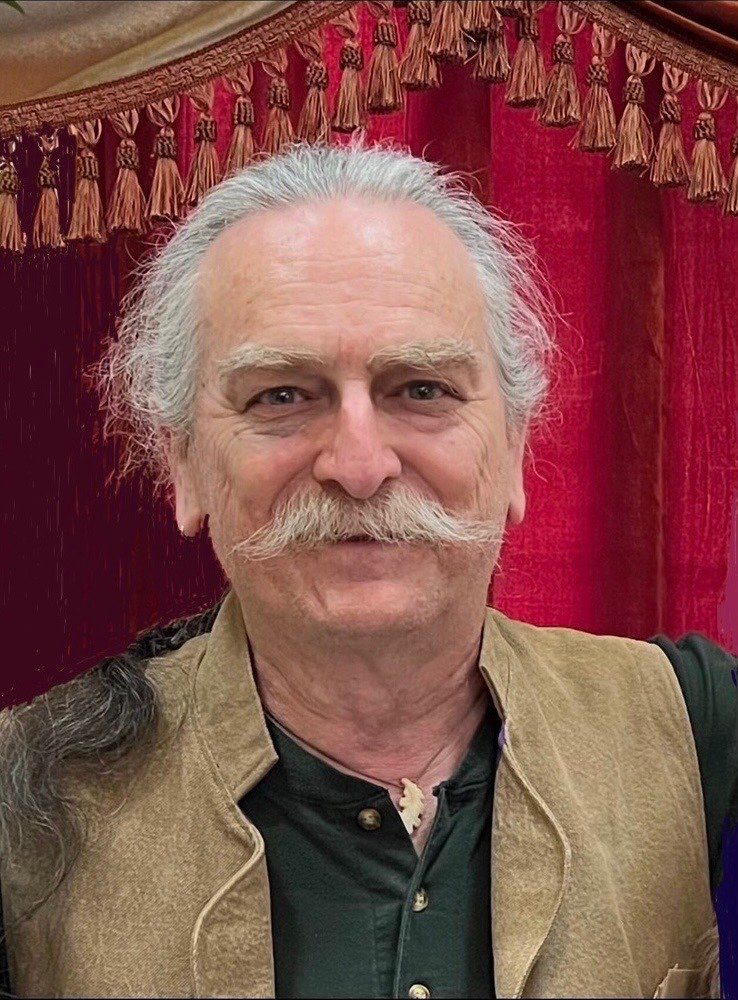
Hakim is Benicia's 10th Poet Laureate and will serve from July 1, 2026 to June 30, 2028.
Laureate
by Hakim
( Coda: Father of all Laureates, Francesco Petrarca was the first person actually named as ‘Poet Laureate.’
The scene was 14th century Italy, and the Black Death bubonic plague brought new sensibilities to the half of the population that survived to see the dawn of the year 1354. )
Daphne
(chased by Apollo,
the god of song & of music)
hides inside a laurel tree:
the bark covering her breast,
her feet rooting in the ground,
face hidden in the laurel foliage —
& yet she’s still beautiful.
And poets
through the ages
have sought to translate
the hidden beauties of life
for tamer spirits to savor.
The Poet Laureate exists
in the world
to gladly be a placeholder –
not as the zero
holds a spot open in numbers —
for there, zero means nothing.
No, the Laureate holds
a place in which
something happens,
an event,
the action of consequence, something to be remembered
by generations of people
from all corners of society.
The Laureate keeps
a particular day
in the collective mind,
a moment
an hour
a feeling —
the bright sky,
or stellar night:
preserving that time,
those moments
in a mosaic made of words.
A living calendar is the Laureate, hand that holds the pen
notes how we all came together
on that certain day
at that chosen hour,
& how we witnessed
those human events
taking place.
This marking of time -
it is a sacred honor,
driving a stake into hard ground, claiming a moment,
holding that spot separate
from all other places,
to commemorate the arrival
or the passing,
the creation, the building of a place
for others far off
in distance or time
to know of it, or
to recall
that shared & unique moment
for all time.
>><><><O><><><>
Francesco Petrarca, also known as Petrarch, was an Italian poet & scholar born in 1304, considered a father of humanism & the modern Italian language.
Petrarca's rediscovery of Cicero's letters is credited with sparking the 14th-century Italian Renaissance. His humanist philosophy & scholarship, which emphasised secular intellectual studies, helped fuel the Renaissance's intellectual growth.
Humanism and its practical applications swept across Europe in the following centuries, most profoundly affecting religion and politics, culminating in a move away from monarchs & the pope in Europe and the formation of an entirely new kind of government in the British colonies that later became the United States of America.
Overlooked except by the most rigorous of scholars, study of Petrarca’s work should be mandated in all schools for every student to be eligible for graduation.
Every month the First Tuesday Poetry Group will select a poem to highlight as the Poem of the Month. Below is August's selection.
IN THE FIELD OF “IGNORANCE IS BLISS”
by Mary DeShaw
Within a boundary of stones and mortar,
there was a field where sheep meandered
lazily, content in the notion that theirs
was the only way to have a good life.
With tender grass to nibble, and long sunny days, they wanted for nothing except that the rest of the world might live as they did.
One day, a ram wandered close to a
broken place in the wall. Noticing a gleaming eye peering through,
he asked, “Who are you, and what do you want with us?”
“I am a wolf, and my pack has come to
help you spread the word,” whispered
the voice on the other side. “If you and your flock let us borrow your clothes, we will go out into the world and convince everyone to conform to your ways.”
Eager to believe the wolf, the ram never asked any more questions. Instead,
he persuaded the whole flock to quickly disrobe and toss their snowy white garments over the wall where the wolf
and his pack were already gleefully
celebrating the success of their trickery.
In the beginning, the pack returned often to the broken wall, telling the deluded and exposed flock lies about how everyone loved the new rules they were being handed, all the while, ravaging the world, obliterating anything that stood in the way of their lust for power. It wasn’t long before the wolves threw the sheep’s clothing into the trash for one simple reason:
They no longer needed cover...
...or the sheep either for that matter.
